How to Choose a Digital Marketing Agency for Successful Business Growth
Getting noticed online is not just about having a website or posting regularly on social media. Businesses need to reach the right audience, communicate what sets them apart, and give customers a reason to choose them.
However, managing all these activities while running a business can be challenging, especially when time, resources, and marketing expertise are limited. This is why many companies turn to experienced digital marketing agencies for professional support.
But not every agency will understand your business or work in the same way. When choosing a digital marketing agency, start by looking at its experience, the services it offers, and how well its approach matches your goals.
Additionally, marketing is also changing with new creative tools and technologies, as creative design gives your brand a distinct look and the growing role of AI as AI is shaping the Future of Digital Marketing. Businesses need an agency that can adapt to these changes while keeping their marketing focused on real customer needs.
Convex Interactive explains how to choose a digital marketing agency, what makes an agency a good fit, what to check before hiring, and how to find the right internet marketing company for your business goals without wasting time or marketing budget.
What Should You Consider Before Choosing a Digital Marketing Agency?
Before approaching an agency, clarify your business goals, target audience, and marketing priorities. This will help you find an agency whose services align with your needs and budget.
1. Identify Your Business Goals and Marketing Needs
Every business has different reasons for investing in digital marketing. You may want to increase website traffic, generate qualified leads, improve brand awareness, or drive more online sales.
Think about the results you want to achieve and set measurable goals over time. For example, if lead generation is your priority, focus on attracting potential customers who are genuinely interested in your products or services.
Clear objectives also help an agency understand what you expect from its services. Instead of recommending a general marketing package, it can develop a strategy aligned with your business priorities and the results you want to achieve.
2. Understand Your Target Audience
Knowing your target audience is just as important as knowing your business goals. Consider who your potential customers are, what they need, and what influences their decisions when they are looking for a product or service.
Look at factors such as age, location, interests, purchasing habits, and the platforms they regularly use. Customer feedback, website analytics, and past sales data can also help you understand which audiences matter most to your business.
Sharing these insights with an agency allows its team to create more relevant campaigns and marketing messages. This way, your marketing efforts can reach people who are more likely to engage with your brand and become customers.
3. Set a Realistic Marketing Budget
Your marketing budget determines which services and campaigns you can comfortably invest in. Before approaching an agency, decide how much you can allocate to marketing without putting unnecessary pressure on your business finances.
Remember that the total cost may include more than the agency’s monthly fee. You also need to account for advertising spend, content creation, website maintenance, marketing software, and other campaign expenses.
A realistic budget helps an agency recommend services that match your available resources. It also clarifies what is included in the proposal, where your money will go, and what additional costs you may need to plan for.
4. Decide Which Marketing Services Your Business Needs
Not every business needs the same mix of digital marketing services. If improving search visibility is your priority, SEO may be worth considering, while paid advertising can help promote specific offers and reach potential customers through targeted campaigns.
Social media marketing can help you build relationships with your audience, while content marketing and email campaigns can keep customers informed about your brand. The right combination depends on your objectives, audience, industry, and available budget.
Before selecting an agency, identify the services that address your most important needs. A suitable agency should explain how each recommended service supports your goals, rather than encouraging you to invest in every available marketing channel.
What to Look for in a Digital Marketing Agency?
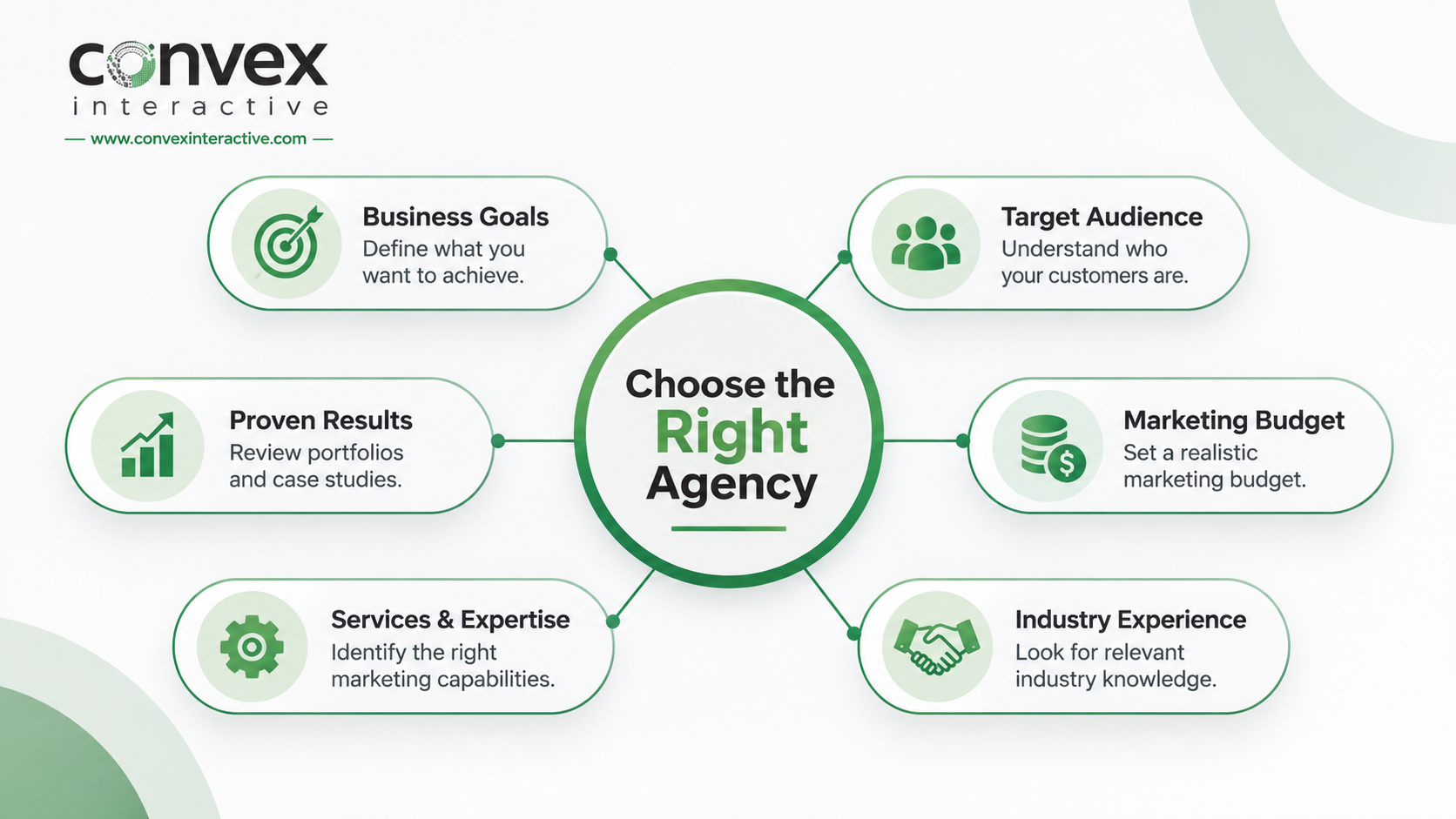
1. Relevant Industry Experience and Expertise
An agency’s experience can show how well it understands your industry and its marketing challenges. Look for a team that has worked with businesses like yours and understands the trends, customer behavior, and competition in your market.
Moreover, check whether the agency can explain how its experience applies to your business. Industry knowledge should help the team make informed decisions, choose suitable channels, and develop strategies that reflect your specific goals.
2. A Strong Portfolio and Proven Case Studies
A portfolio offers a closer look at an agency’s past work and the types of projects it has handled. Review its campaigns, website projects, content, and other relevant examples to determine whether the quality and approach meet your expectations.
Also, look for case studies that explain a project’s challenge, strategy, and results. Specific details, such as increased website traffic or improved lead generation, can help you understand the agency’s contribution rather than relying on broad claims.
3. A Team with the Right Marketing Skills
Digital marketing encompasses several areas of expertise, including SEO, paid advertising, social media, content creation, and data analysis. Check whether the agency has professionals with the skills to manage the services your business plans to use.
Beyond that, find out who will handle your account and how the team members will collaborate. A well-coordinated team can keep marketing activities aligned and ensure that each part of your strategy supports the same business objectives.
4. Creative Thinking and Strategic Planning
A suitable agency should develop ideas that align with your brand rather than using the same approach for every client. Look for a team that understands your market, identifies opportunities, and creates campaigns that deliver a clear, relevant message for your business.
Equally important, creativity should be supported by a clear strategy, as the agency explains why it recommends certain channels, how each activity connects to your goals, and how it plans to assess and improve campaign performance.
5. Clear Communication and Client Support
Good communication helps you understand what an agency is doing and how your campaigns are progressing. Before deciding, consider how clearly the team answers your questions, explains its services, and sets expectations during initial conversations.
Furthermore, ask how often you will receive updates, who your main point of contact will be, and how quickly the team usually responds. Consistent support makes it easier to address concerns, discuss changes, and maintain a productive working relationship.
How to Evaluate a Digital Marketing Agency’s Services
Digital marketing services can vary significantly in approach, execution, and results. Before choosing an agency, look beyond its list of services and assess how well its team can manage each area to support your business goals.
1. Search Engine Optimization (SEO)
SEO helps improve your website’s visibility in organic search results and makes it easier for potential customers to find your business. When evaluating an agency’s SEO services, check its approach to keyword research, technical optimization, on-page improvements, content quality, and link-building.
Furthermore, ask how the agency plans to measure progress and sustain your website’s search performance. A capable SEO team should explain its methods, identify areas for improvement, and set realistic expectations rather than promise guaranteed rankings.
2. Pay-Per-Click Advertising (PPC)
PPC advertising enables businesses to reach potential customers through paid placements on platforms such as Google Ads. Evaluate whether the agency can effectively manage campaign setup, keyword targeting, audience selection, ad creation, bidding, and budget allocation.
In addition, ask how the team monitors advertising costs and evaluates campaign performance. Look for an approach that prioritizes relevant clicks, qualified leads, conversions, and return on ad spend rather than simply increasing click volume.
3. Social Media Marketing
Social media marketing involves creating and managing content across platforms such as Facebook, Instagram, LinkedIn, and TikTok. The agency understands the platforms your audience uses and can develop content that reflects your brand’s voice and communication style.
At the same time, assess how the team plans its content calendar, manages audience engagement, and adapts its approach to each platform. Its strategy should focus on meaningful interactions and business objectives rather than follower numbers alone.
4. Content Marketing
Content marketing helps businesses attract and inform potential customers with useful, relevant content. An agency offering this service should know how to plan and produce a range of formats, including blog posts, website copy, videos, infographics, and downloadable resources.
More importantly, determine how the agency aligns content creation with your audience’s needs and buying journey. Its approach should include topic research, content distribution, quality checks, and performance reviews to ensure each piece serves a clear purpose.
5. Email Marketing and Marketing Automation
Email marketing gives businesses a direct way to communicate with subscribers, share updates, promote offers, and maintain customer relationships. When assessing this service, look at the agency’s experience with email campaigns, audience segmentation, list management, and campaign design.
Alongside this, ask whether the team can set up automated workflows, such as welcome emails, follow-up messages, and abandoned-cart reminders. These features should be designed around customer behavior and measured using relevant indicators such as clicks, conversions, and engagement.
6. Website Design and Development
Your website plays an important role in how customers explore your business and interact with your brand. Review the agency’s ability to create websites that are visually consistent, easy to navigate, mobile-friendly, secure, and built around a clear user experience.
Beyond appearance, ask how the team handles website speed, functionality, search engine requirements, and ongoing maintenance. A well-developed website should not only represent your brand professionally but also make it easier for visitors to take meaningful actions, such as making inquiries or completing purchases.
How to Compare Different Digital Marketing Agencies
1. Review Client Testimonials and Online Reputation
Client testimonials can provide valuable insight into an agency’s working style, service quality, and ability to maintain professional relationships. Read reviews on independent platforms, business directories, and social media to understand what previous clients say about their experiences.
However, do not rely solely on positive ratings when making your decision. Look for detailed feedback, relevant client references, and consistent comments on communication, project delivery, and results to build a more balanced view of the agency.
2. Compare Marketing Strategies and Service Packages
Every agency may approach your marketing needs differently, even when offering similar services. Review their proposals to understand the recommended channels, campaign objectives, planned activities, timelines, and the specific deliverables included in each package.
Similarly, compare what you will receive for the quoted price rather than choosing an agency based on cost alone. Check whether services such as content production, advertising management, technical support, and reporting are included or charged separately.
3. Assess Reporting and Performance Tracking
Regular reporting helps you understand how an agency manages your campaigns and whether its work is contributing to your business objectives. Request a sample report and check for metrics on traffic, search visibility, leads, conversions, and campaign costs.
Also ask how often they share reports and whether the team explains the results clearly. A useful report should highlight progress, identify areas that need attention, and outline the actions the agency plans to take next.
4. Check Certifications, Partnerships, and Industry Recognition
Professional certifications and recognized industry partnerships can provide additional insight into an agency’s training and platform knowledge. The team holds relevant Google Ads or Analytics certifications and recognized partnerships with platforms used for client campaigns.
What Should You Ask Before Hiring a Digital Marketing Agency?
1. Who Will Manage Your Marketing Campaigns?
Before signing an agreement, determine who will manage your marketing activities and who you will contact for updates. Ask whether an in-house team, a dedicated account manager, or external specialists will handle your campaigns.
2. How Will You Measure Campaign Performance?
Ask the agency which metrics it will use to judge the success of your campaigns and how they relate to your business goals. For example, a lead generation campaign should focus on inquiries and conversions rather than website visits alone.
3. What Results Can You Realistically Expect?
Discuss the results the agency believes it can achieve based on your current position, competition, budget, and chosen marketing channels. A reliable team should explain potential delays, factors affecting progress, and outcomes it cannot guarantee.
4. How Often Will You Receive Progress Reports?
Ask how often the agency will share updates and what information those reports will include. You should have a clear schedule for reviewing campaign activity, discussing concerns, and tracking progress toward your agreed goals.
5. Can You Share Examples of Previous Client Results?
Ask the agency to show relevant projects that demonstrate its experience in handling campaigns similar to yours. Look for examples of completed work, challenges, and outcomes, noting that results vary by business.
How Much Does It Cost to Hire a Digital Marketing Agency?
1. Factors That Influence Agency Pricing
The cost of hiring a digital marketing agency depends on the services you need, the size of your campaigns, and the amount of work involved. Pricing may also vary according to the agency’s experience, team size, industry requirements, and level of ongoing support.
2. Monthly Retainers vs Project-Based Pricing
Agencies commonly charge through monthly retainers or fixed project fees, depending on the type of work they provide. A retainer suits businesses that need continuous marketing support, while project-based pricing may work better for one-time tasks such as website development or a campaign launch.
3. Agency Fees vs Advertising Budget
When reviewing a proposal, make sure you understand the difference between the agency’s service charges and the money spent on advertising. Agency fees cover the work involved in managing campaigns, while the advertising budget goes toward paid placements on platforms such as Google, Facebook, and Instagram.
4. How to Select an Agency That Fits Your Budget
Choose an agency whose pricing fits your budget and the level of support your business requires. Instead of choosing the cheapest package, review the included services, expected workload, payment terms, and any additional charges before committing.
Things to Consider When Choosing a Digital Marketing Agency
1. Guaranteed Rankings and Unrealistic Promises
Be cautious of agencies that guarantee first-page Google rankings, instant results, or a fixed number of sales within a short period. Search performance and campaign outcomes depend on several factors, so a trustworthy agency will discuss realistic targets rather than making promises it cannot control.
2. Unclear Pricing and Hidden Charges
An agency should clearly explain its fees before you agree to work together. Be careful if the proposal omits important costs, uses vague service descriptions, or fails to explain whether additional work will incur extra charges.
3. Poor Communication and Lack of Transparency
Pay attention to how the agency communicates during your initial discussions, as this can give you a sense of what working together may be like. Delayed replies, unclear answers, and reluctance to explain decisions may create problems once your campaigns are underway.
4. No Verifiable Results or Client References
An agency should be able to provide examples of its work and evidence to support the results it claims to have achieved. If it cannot share relevant case studies, references, or credible project details, take time to assess its experience before moving forward.
5. Long-Term Contracts with Unclear Deliverables
Read the agreement carefully before committing to a long-term partnership, especially if the agency has not clearly explained what its services include. Make sure the contract outlines the scope of work, expected timelines, payment terms, cancellation conditions, and both parties’ responsibilities.
What Should You Know About AI and Digital Marketing Agencies in 2026?
1. How Agencies Use AI in Marketing Campaigns
Digital marketing agencies increasingly use AI tools to support tasks such as audience research, campaign analysis, content planning, and performance reporting. These tools can help teams work more efficiently, but you should understand how the agency uses them and where human review remains essential.
2. AI-Powered SEO and Changing Search Behavior
AI is reshaping how people discover information online, including how they interact with search engines and AI-powered search experiences. Ask whether the agency keeps pace with these changes and how it plans to improve your website’s visibility through useful content, technical SEO, and relevant information.
3. Why Human Expertise and Content Quality Still Matter?
AI can help with research and content production, but it doesn’t replace a clear understanding of your audience, industry, and brand. A capable agency should use human judgment to verify accuracy, add meaningful insights, and ensure its content offers genuine value to readers.
4. Data Privacy, Automation, and Responsible AI Use
AI-powered marketing tools may process customer information, campaign data, and other business details, making responsible data handling important. Ask how the agency safeguards sensitive data, controls marketing-platform access, and ensures automated activities meet privacy requirements.
What Should You Expect During the First 90 Days with a Digital Marketing Agency?
1. Initial Business Research and Marketing Audit
The first stage typically involves learning about your business, reviewing its current marketing activities, and identifying areas that need attention. The agency may review your website, existing campaigns, competitors, audience data, and online presence before recommending any major changes.
2. Strategy Development and Campaign Planning
After completing its initial research, the agency should prepare a strategy based on your objectives, audience, budget, and available resources. This plan should explain which marketing channels will be used, what activities will take place, and how the work will be organized over the coming months.
3. Campaign Launch and Performance Monitoring
Once the plan is approved, the agency can begin setting up and launching the agreed campaigns across the selected channels. During this stage, its team should confirm everything is working correctly, monitor early performance, and address any issues that arise after launch.
4. Reviewing Results and Improving the Strategy
As campaign data becomes available, the agency should review what is working and where adjustments may be needed. It can then refine targeting, content, budgets, or other campaign elements based on actual performance and the goals agreed at the start.
How to Make the Final Decision and Choose the Right Agency
1. Compare Your Shortlisted Agencies
After speaking with potential agencies, compare their experience, proposed approach, pricing, and ability to meet your business requirements. Consider which team understands your priorities best and gives you confidence in its ability to manage the work.
2. Review the Proposal and Contract
Before accepting an offer, read the proposal and contract to understand exactly what the agency has agreed to provide. Check the scope of work, fees, payment schedule, project terms, and conditions for making changes or ending the agreement.
3. Confirm Account Ownership and Access
Make sure your business retains ownership of important digital assets, including its website, domain, advertising accounts, analytics tools, and social media profiles. The agency should receive the access needed to perform its work without taking ownership away from your business.
4. Agree on Deliverables, Timelines, and Expectations
Before the partnership begins, confirm the tasks the agency will complete, when each task is due, and how progress will be reviewed. Having these details agreed in writing helps both sides understand their responsibilities and work towards the same objectives.
Where Convex Interactive Fits Into Your Digital Marketing Strategy
Convex Interactive helps businesses build a stronger online presence through marketing that connects with their goals and audience. Our approach brings strategy, creativity, and performance together, so every activity has a clear purpose. From building brand awareness to generating leads, we help businesses make meaningful progress.
A successful campaign needs more than good ideas; it also needs the right direction and ongoing attention. Through our digital marketing services, we help businesses reach the right audience, while marketing analytics provides valuable insights into campaign performance and areas for improvement.
Our paid media services support this approach by helping brands reach potential customers through targeted advertising, where the best results come with the best visibility.
At Convex Interactive, we believe strong marketing starts with understanding your business and making every effort count. We work closely with our clients to develop strategies that fit their needs, track progress, and adapt as their goals change. The aim is to build a marketing partnership that supports steady growth and lasting results.
Have questions about choosing the right digital marketing agency for your business? The team at Convex Interactive is here to help you find the right approach for your marketing needs. Get in touch with us to discuss your goals and explore how we can support your business growth.
FAQs
How can you choose the right digital marketing agency for your business?
Choosing the right agency starts with knowing what you want to achieve, whether it is improving online visibility, attracting more customers, or increasing sales. Before deciding, review its work, industry experience, services, and grasp of your business goals.
What should you check before hiring a digital marketing agency?
Before hiring an agency, review its portfolio, client feedback, case studies, and past campaign results. You should also understand how the team communicates, plans marketing activities, and shares progress reports.
How can you tell if a digital marketing agency has real experience?
An experienced agency should be able to share examples of its past campaigns and explain the results it has achieved for clients. You can also check customer reviews and ask about its experience with businesses similar to yours.
Should you choose a specialized digital marketing agency or a full-service agency?
A specialized agency focuses on specific services such as SEO, social media marketing, or paid advertising, making it a good fit when you need help in one area. A full-service agency combines marketing activities to support a broader business strategy.
How can you know if a digital marketing agency is delivering good results?
You can measure an agency’s performance by looking at website traffic, qualified leads, conversion rates, and sales rather than focusing only on clicks and impressions. Daily reports should show campaign performance and progress toward business goals.