WhatsApp Business API Pricing Guide: 2026 Pricing Breakdown
WhatsApp Business API pricing mainly comes down to two costs: Meta’s per-message charges and any software or platform fees from your Business Solution Provider (BSP) or technology partner.
Since July 1, 2025, Meta has used per-message pricing, with charges based on message category and the recipient’s country code. Effective October 1, 2026, new billing rules will also apply to Service Messages and Utility Templates sent within the 24-hour customer service window.
For businesses using WhatsApp for marketing, sales, support, or transactional messaging, tracking these changes can help avoid unexpected costs.
Convex Interactive’s WhatsApp Business API guide explains how the API works, what businesses need to know about messaging, and the key factors to consider when using WhatsApp for customer communication.
How WhatsApp Business API Pricing Works
WhatsApp Business API pricing is based on the type of message you send and the recipient’s market, not a flat fee for using the platform.
Meta applies different rates to different business message categories, so your total cost depends on the kind of communication you send and how much you use WhatsApp for customer engagement.
The main message categories are:
- Marketing: Promotional campaigns, offers, product recommendations, and other messages intended to encourage customer action.
- Utility: Transactional or customer-requested updates, including order confirmations, shipping notifications, and appointment reminders.
- Authentication: Messages containing one-time passcodes or other information used to verify a customer’s identity.
- Service: Customer support messages sent in response to a customer-initiated conversation.
The key point to understand is that not every WhatsApp message costs the same. Meta’s pricing varies by category and market, and certain customer-service interactions may be priced differently depending on how and when the conversation is initiated.
That’s why businesses should look beyond a simple “cost per message” figure and consider their actual messaging mix when estimating WhatsApp Business API costs.
WhatsApp Business API Message Categories
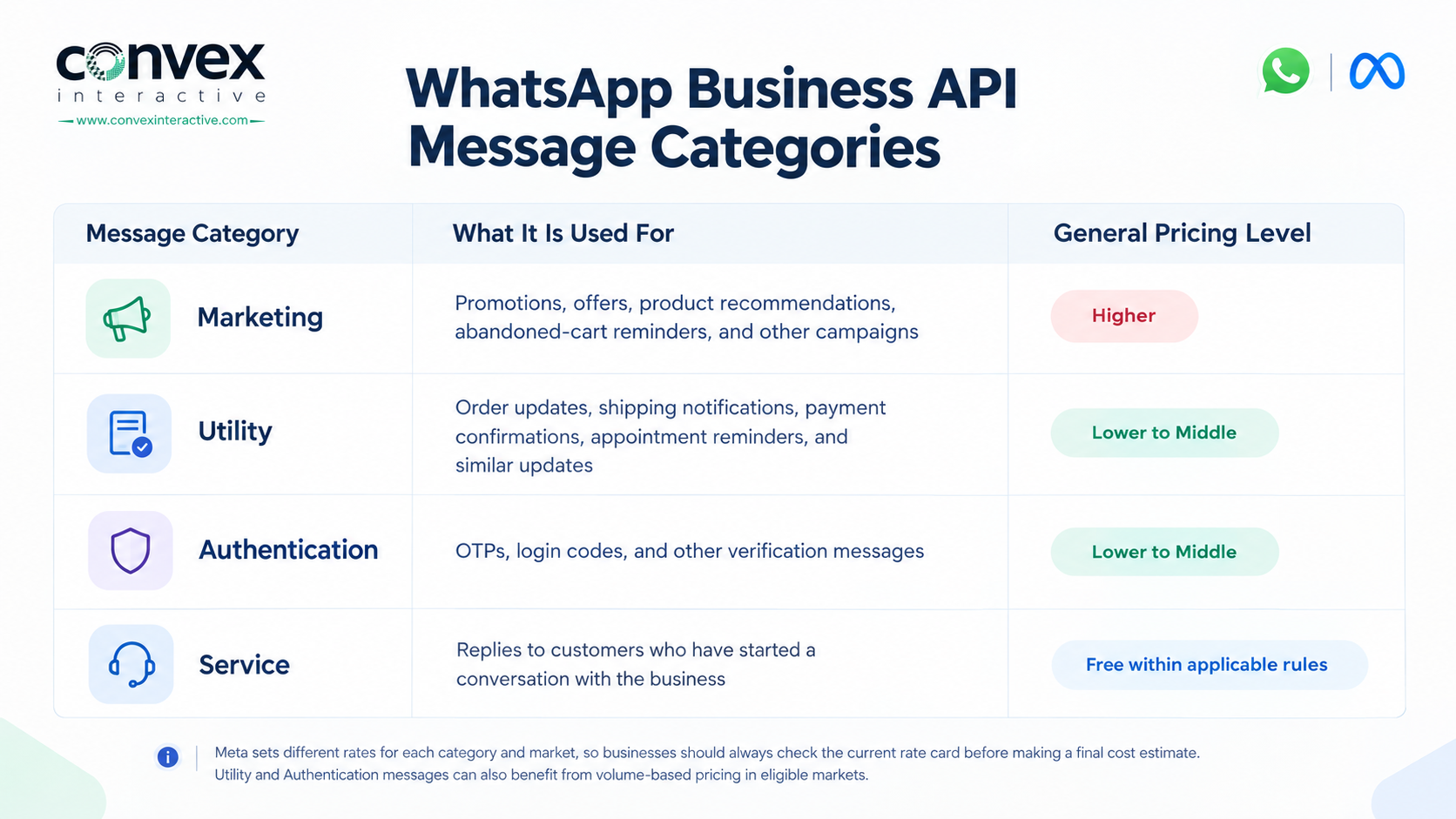
| Message Category | What It Is Used For | General Pricing Level |
| Marketing | Promotions, offers, product recommendations, abandoned-cart reminders, and other campaigns | Higher |
| Utility | Order updates, shipping notifications, payment confirmations, appointment reminders, and similar updates | Lower to Middle |
| Authentication | OTPs, login codes, and other verification messages | Lower to Middle |
| Service | Replies to customers who have started a conversation with the business | Free within applicable rules |
Meta sets different rates for each category and market, so businesses should always check the current rate card before making a final cost estimate. Utility and Authentication messages can also benefit from volume-based pricing in eligible markets.
What Is Changing on October 1, 2026?
The most significant pricing change for businesses using the WhatsApp Business Platform takes effect on October 1, 2026. The 24-hour customer service window is not going away, but Meta is changing how it charges for messages within that window.
Two types of messages are affected:
- Service messages: Free-form replies sent by an agent, chatbot, or other business system inside the 24-hour customer service window will become billable after the free monthly allowance.
- Utility messages: Utility templates sent while that 24-hour window is open will also become billable instead of remaining free.
Meta introduces a monthly free allowance of 1,000 service messages per business phone number, resetting each month with no carryover. Extra messages incur market-rate charges.
The 24-hour customer service window remains, as it still opens when a customer messages the business and continues to allow customer-service replies during that period. The change is mainly about whether those replies are free or billable.
What Still Stays Free?
The October change does not mean every WhatsApp interaction becomes paid. Some parts of the WhatsApp Business Platform still have free treatment under Meta’s pricing rules.
- Customer messages: Businesses aren’t charged just for receiving a WhatsApp message.
- Free service allowance: Each business phone number receives a monthly allowance of service messages before charges begin.
- Eligible free entry points: Conversations started through eligible Click-to-WhatsApp ads or Facebook Page call-to-action buttons can receive a free entry-point window.
- WhatsApp Business App: These pricing changes apply to the WhatsApp Business Platform/API, not the WhatsApp Business App.
Meta’s free entry-point window is 72 hours, during which messages sent after a customer enters via an eligible ad or Facebook Page CTA aren’t charged. Businesses should check Meta’s latest rules as these conditions may change.
WhatsApp API Pricing Depends on the Customer’s Market
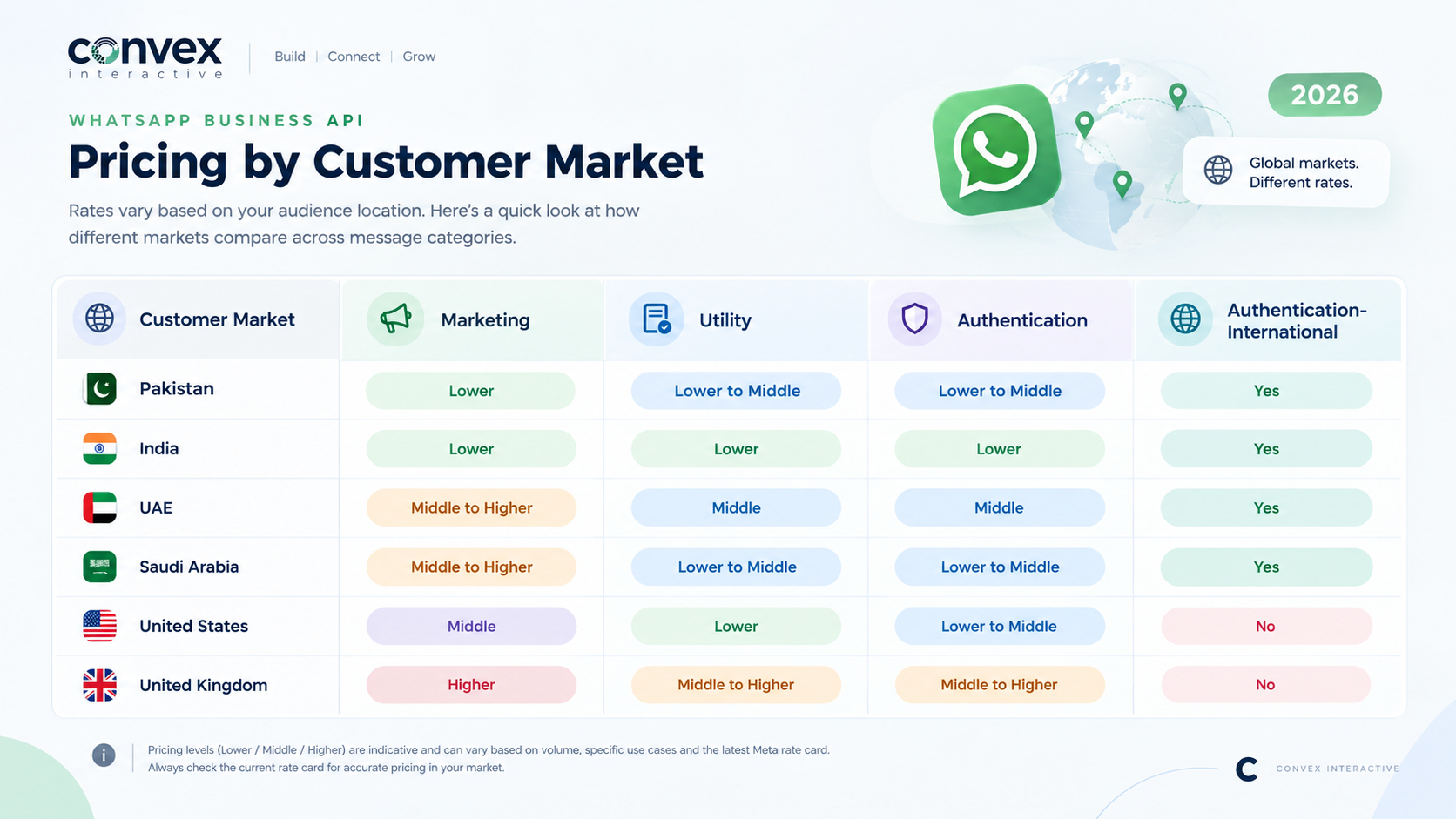
Another important part of WhatsApp pricing is the customer’s market. Meta does not use a single worldwide rate for every business. Pricing varies by market and message category, so the same type of message can cost different amounts depending on where the customer receives it.
For a business serving customers across multiple countries, it makes more sense to look at the general pricing pattern than to rely on one fixed number.
|
Customer Market |
Marketing | Utility | Authentication |
Authentication-International |
|
Pakistan |
Lower | Lower to Middle | Lower to Middle |
Yes |
|
India |
Lower | Lower | Lower |
Yes |
|
UAE |
Middle to Higher | Middle | Middle |
Yes |
|
Saudi Arabia |
Middle to Higher | Lower to Middle | Lower to Middle |
Yes |
|
United States |
Middle | Lower | Lower to Middle |
No |
| United Kingdom | Higher | Middle to Higher | Middle to Higher |
No |
Pakistan’s utility and authentication rates increased as of April 1, 2026; worth checking current figures if you’re budgeting for the Pakistani market specifically.
The Authentication-International rate is worth knowing regardless of where you’re based: if your WhatsApp Business Account is registered outside the recipient’s country and you’re sending OTPs into Pakistan, Saudi Arabia, or the UAE, the rate runs higher than the domestic rate. Registering your WABA locally for these markets can meaningfully cut that cost.
For the exact current rate in any market, including Pakistan, Meta publishes live rate cards by currency, downloadable directly from their developer documentation. That’s the only number worth trusting, since it updates in real time and this guide can’t.
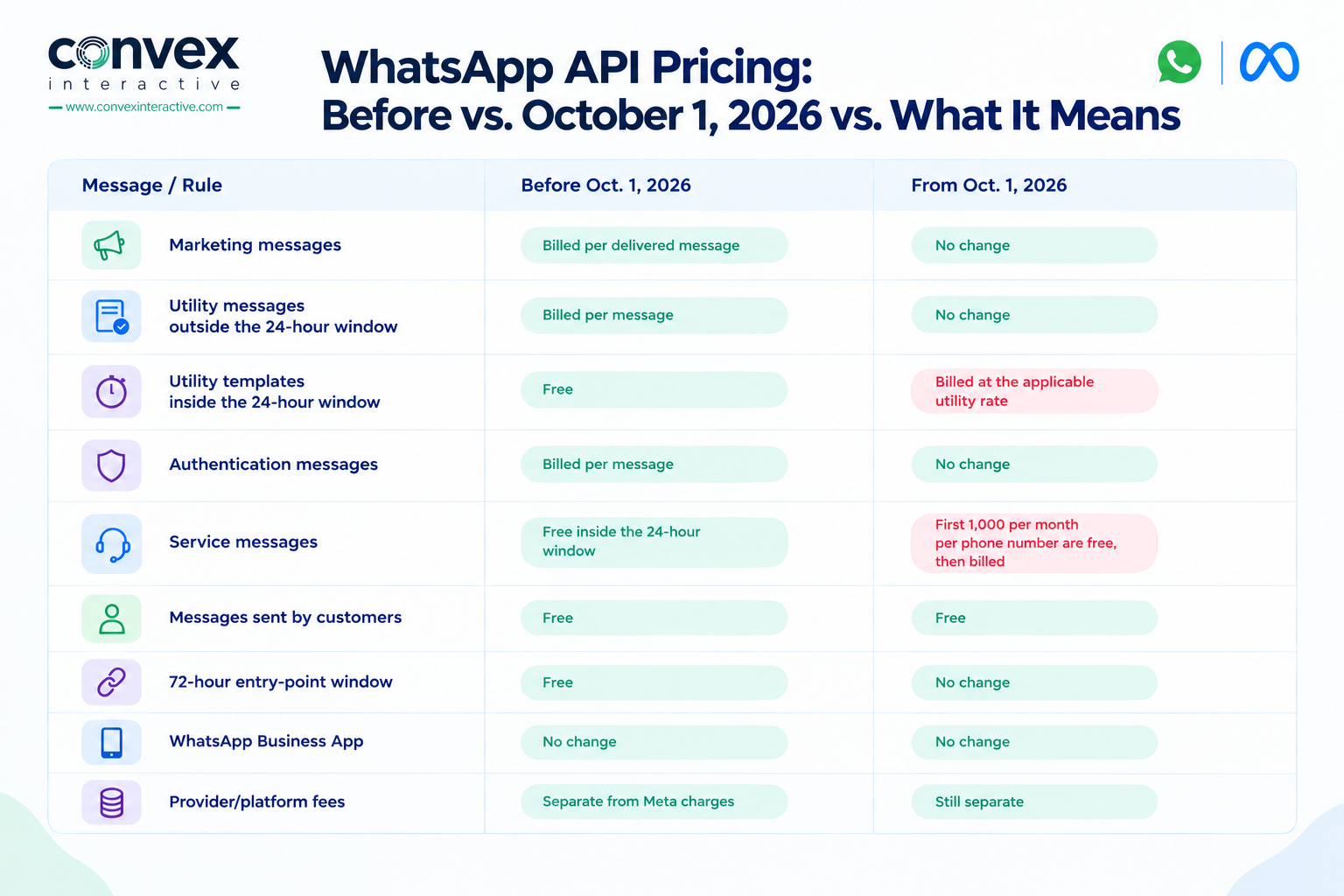
WhatsApp API Pricing: Before vs. October 1, 2026 vs. What It Means
|
Message / Rule |
Before Oct. 1, 2026 | From Oct. 1, 2026 | What It Means for Businesses |
| Marketing messages | Billed per delivered message | No change | Marketing campaigns continue under the existing category-based pricing model. |
| Utility messages outside the 24-hour window | Billed per message | No change | Standard utility template charges still apply. |
| Utility templates inside the 24-hour window | Free | Billed at the applicable utility rate | Businesses need to account for these messages in their API budget. |
| Authentication messages | Billed per message | No change | OTPs and other authentication templates continue under existing pricing rules. |
| Service messages | Free inside the 24-hour window | First 1,000 per month per phone number are free, then billed | High-volume customer support teams may see a new messaging cost. |
| Messages sent by customers | Free | Free | Customers can still message your business without creating a Meta messaging charge. |
| 72-hour entry-point window | Free | No change | Eligible Click-to-WhatsApp ads and Facebook Page CTA conversations can continue under the entry-point rules. |
| WhatsApp Business App | No change | No change | These pricing changes apply to the WhatsApp Business Platform/API, not normal Business App usage. |
| Provider/platform fees | Separate from Meta charges | Still separate |
Businesses should check both Meta messaging charges and their provider’s platform or service fees. |
What Are the Two Costs in WhatsApp API Pricing?
Your WhatsApp API cost typically has two components: Meta’s messaging charges and your provider’s platform fee. Meta charges based on message category and customer market, while your provider may charge for the platform and services you use.
These costs are separate, so always check both before choosing a provider. Looking only at the monthly platform fee can give you an incomplete picture of your actual WhatsApp API cost.
For businesses comparing providers, you can also explore Convex Interactive’s guide on choosing a WhatsApp Business API provider and what to check beyond the advertised plan.
How to Estimate Your WhatsApp API Cost
You don’t need a complicated calculation to get a useful starting estimate. The easiest approach is to look at how your business actually uses WhatsApp.
- Check your message mix: Look at how many messages you send for marketing, utility, authentication, and customer service.
- Separate your customer markets: If you serve customers in different countries, don’t treat all messages the same.
- Check the current Meta rate card: Use the latest market and category information, not an old pricing table.
- Watch your service-message volume: From October 1, the first 1,000 eligible service messages per business phone number are free each month, with additional messages becoming billable.
- Add your provider costs: Include your BSP or platform subscription, markup, setup charges, or other applicable fees.
- Review your messaging habits: Sending fewer, more useful messages can help keep your WhatsApp costs under control while also improving the customer experience.
The key is to calculate costs based on your actual messaging patterns, rather than assuming every WhatsApp message costs the same.
Check the Latest WhatsApp Pricing Before You Budget
WhatsApp pricing can change by market, category, and pricing update, so fixed figures published in older blogs can quickly become outdated. For the most reliable information, check Meta’s official WhatsApp Business Platform pricing page before planning a campaign or calculating your expected monthly cost.
Moreover, Meta’s latest pricing changes will affect how businesses are charged for certain WhatsApp messages starting October 1, 2026. To understand the changes in detail, read our guide, Meta Introduces New WhatsApp Business Pricing, and see what they mean for your messaging costs.
FAQs
How is WhatsApp Business API pricing calculated?
WhatsApp Business Platform pricing is primarily based on the messages a business sends, with costs varying by the recipient’s country and message category, such as marketing, utility, or authentication. Certain eligible messages can be free under Meta’s pricing rules.
Is WhatsApp Business API free for businesses?
No, the WhatsApp Business Platform isn’t free. Meta charges for messages when applicable, and businesses might also pay for the solution partner or provider they choose.
What affects the total cost of WhatsApp Business API?
Your overall WhatsApp API cost can depend on message category, recipient country, message volume, and applicable pricing tiers. If you use a Solution Partner, its platform or service charges may also be separate from Meta’s messaging fees.