IPTV vs OTT: What Is the Difference and Which One Do You Need?
In the past, television viewers relied mainly on cable and satellite services to watch their favorite programs. However, in 2026, shifting viewing habits and advances in internet technology have made comparing OTT and IPTV an important consideration for audiences and businesses exploring modern TV solutions.
Although both technologies deliver video over IP networks, they differ in how content reaches viewers. IPTV typically uses a managed network, while OTT platforms deliver content over the public internet, letting viewers stream on compatible devices.
In Pakistan and the wider Middle East, platforms such as Mjunoon, Tamasha, Shahid, and STARZPLAY offer digital entertainment options. Global platforms such as Netflix and YouTube also let viewers access content over the internet.
In this blog, Convex Interactive explains the difference between IPTV and OTT, compares their features and limitations, and identifies which option may best suit different viewing preferences and business goals in 2026.
IPTV vs OTT: Key Differences Explained
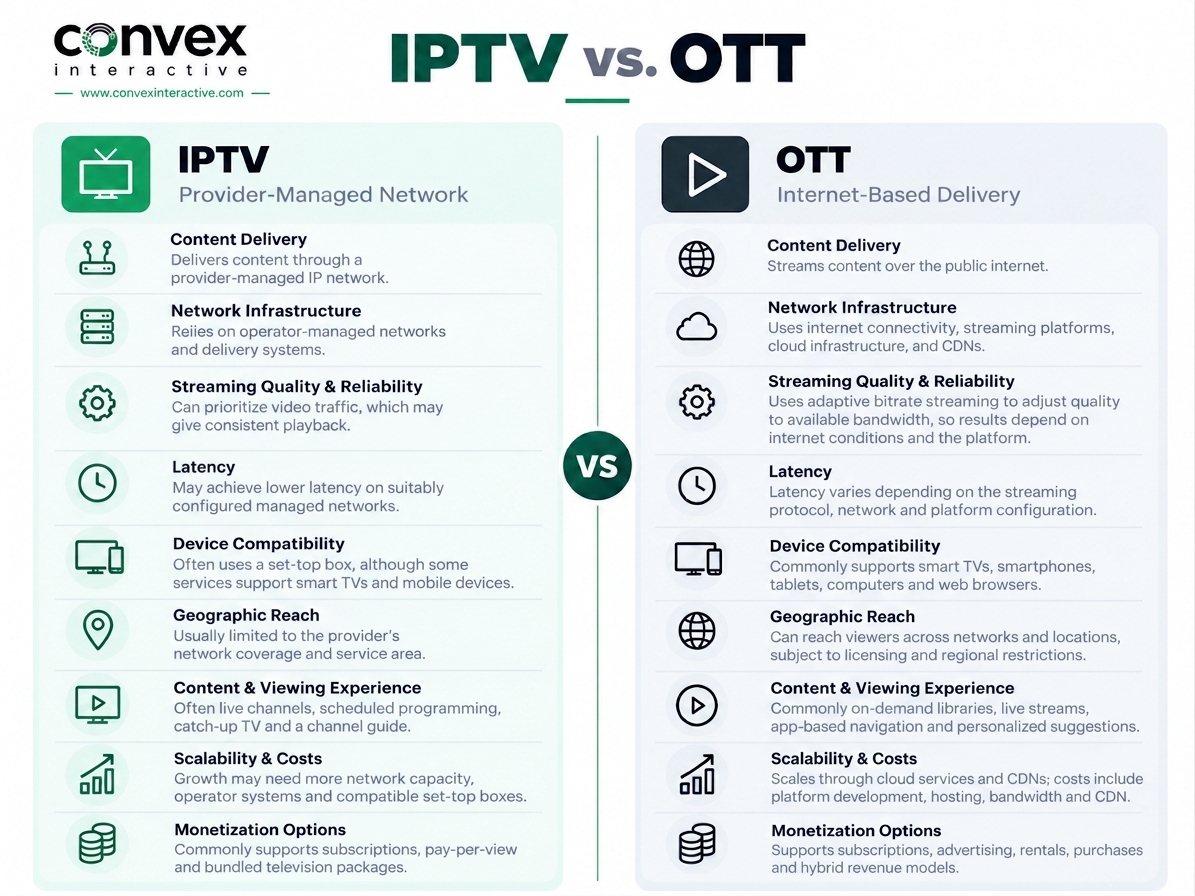
IPTV and OTT both stream video online, but differ in delivery: IPTV uses a provider-managed network, while OTT uses the public internet. This affects network control, device access, performance, and cost.
| Comparison factor | IPTV | OTT |
| Content delivery | Delivers content through a provider-managed IP network. | Streams content over the public internet. |
| Network infrastructure | Relies on operator-managed networks and delivery systems. | Uses internet connectivity, streaming platforms, cloud infrastructure, and CDNs. |
| Streaming quality and reliability | Managed networks can prioritize video traffic, which may give consistent playback. | Adaptive bitrate streaming adjusts quality to available bandwidth, so results depend on internet conditions and the platform. |
| Latency | May achieve lower latency on suitably configured managed networks. | Latency varies depending on the streaming protocol, network and platform configuration. |
| Device compatibility | Often uses a set-top box, although some services support smart TVs and mobile devices. | Commonly supports smart TVs, smartphones, tablets, computers and web browsers. |
| Geographic reach | Usually limited to the provider’s network coverage and service area. | Can reach viewers across networks and locations, subject to licensing and regional restrictions. |
| Content and viewing experience | Often live channels, scheduled programming, catch-up TV and a channel guide. | Commonly on-demand libraries, live streams, app-based navigation and personalized suggestions. |
| Scalability and costs | Growth may need more network capacity, operator systems and compatible set-top boxes. | Scales through cloud services and CDNs; costs include platform development, hosting, bandwidth and CDN. |
| Monetization options | Commonly supports subscriptions, pay-per-view and bundled television packages. | Supports subscriptions, advertising, rentals, purchases and hybrid revenue models. |
IPTV relies on managed networks for content delivery, while OTT offers greater flexibility across devices, audiences and viewing experiences. Additionally, businesses planning a streaming service can get OTT audio and video streaming solutions and OTT platforms make money through subscriptions, advertising and other revenue models to find an approach that aligns with their goals.
What Is IPTV?
IPTV (Internet Protocol Television) delivers television content through internet protocol (IP) networks instead of traditional cable or satellite signals.
Unlike conventional TV services, IPTV typically uses a managed network run by a telecom company or internet service provider (ISP), allowing the provider to control how video content reaches subscribers.
Moreover, IPTV services often use a set-top box connected to the television, although some services also support compatible smart TVs and other devices. For example, an internet provider might offer customers a TV package with live news, sports, and entertainment channels delivered through its own network.
This gives viewers a familiar channel-based experience while allowing features such as video on demand and catch-up TV, depending on the service. However, IPTV performance and available features vary by provider and network setup.
How Does IPTV Work?
IPTV delivers television through a series of steps:
- Content preparation: The provider receives video content and prepares it for digital delivery.
- Network distribution: The operator sends the content through its managed IP network to subscribers.
- Stream reception: A set-top box or another compatible device receives the video stream.
- Playback: The device decodes the stream and displays the content on the viewer’s TV.
Providers can improve delivery by using multicast to send one stream to viewers of the same live channel and QoS to prioritize video traffic for smoother playback.
What is OTT?
OTT (Over-the-Top) streaming delivers video content directly to viewers over the public internet, without requiring a traditional cable or satellite TV service. Instead of receiving channels OTT platforms through a specific television provider’s network, users can access content on streaming platforms via smart TVs, smartphones, tablets, and web browsers.
For example, services such as Netflix and YouTube let viewers watch movies, shows, and videos whenever they choose, as long as they have a reliable internet connection. In addition, OTT is not limited to on-demand entertainment; it can also deliver live sports, news broadcasts, and other real-time events.
This flexibility helps content providers reach audiences across devices and networks, but viewing quality depends on connection speed, platform, and device.
How Does OTT Work?
OTT streaming follows four main steps:
- Content preparation: Videos are uploaded, encoded, and prepared for online delivery.
- Content distribution: A Content Delivery Network (CDN) stores and distributes video from servers closer to viewers.
- Viewer access: Users connect to the platform through the internet and select their preferred content.
- Video playback: An OTT app or web player streams the content to the viewer’s device.
To improve playback, many platforms use adaptive bitrate streaming, which automatically adjusts video quality to match the viewer’s available internet speed. This helps reduce buffering when connection conditions change.
Pros and Cons of OTT and IPTV
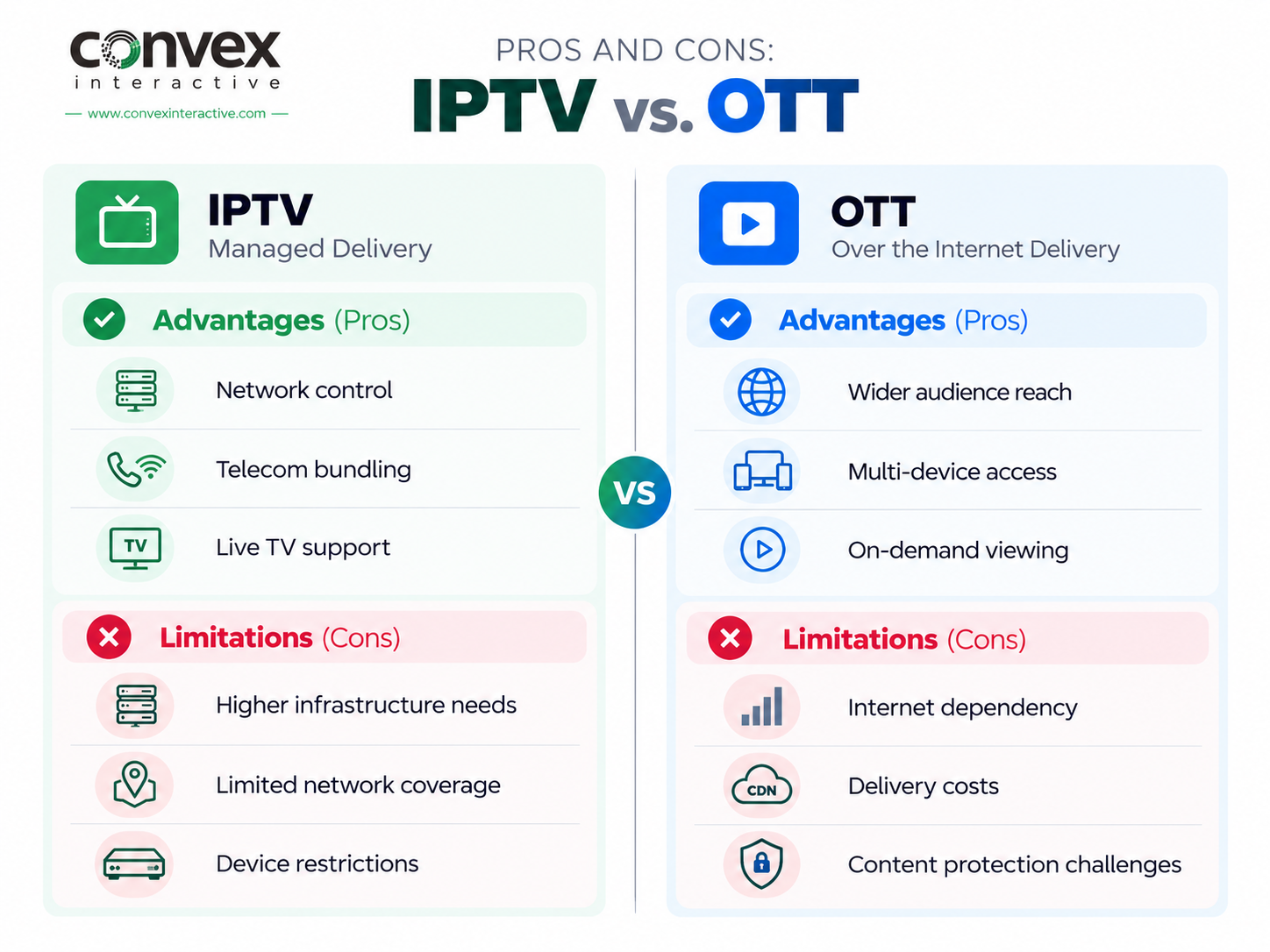
Advantages and Limitations of IPTV
Advantages
- Better network control: Managed networks give providers greater control over content delivery and traffic.
- Telecom integration: IPTV can be bundled with broadband, phone, and other communication services.
- Live TV support: IPTV can provide organized channel guides and scheduled programming for a traditional TV experience.
Limitations
- Higher infrastructure needs: Providers may need dedicated network systems and compatible equipment.
- Limited availability: Access can depend on the provider’s network coverage and service area.
- Device restrictions: Some services require specific set-top boxes or approved devices.
Advantages and Limitations of OTT
Advantages
- Wider audience reach: OTT can deliver content to viewers across regions via the internet, without the business building its own access network.
- Multi-device access: Users can stream on smart TVs, smartphones, tablets, and computers.
- On-demand viewing: Viewers can watch content at a convenient time instead of following fixed schedules.
Limitations
- Internet dependency: Streaming quality can vary with connection speed and network congestion.
- Delivery costs: CDN usage, bandwidth, and video processing can become expensive as viewership grows.
- Content protection: Providers must manage access controls and digital rights to help prevent unauthorized distribution.
Real-World Examples of OTT and IPTV
IPTV uses an operator-managed network; OTT streams over the public internet. Some telecom providers offer both traditional TV and streaming apps on supported devices.
- IPTV: AT&T U-verse TV and Operator-managed TV services are legacy television services delivered through a provider-managed network.
- OTT: Netflix, which offers movies, series, and documentaries through internet-connected devices.
- OTT: Tamasha, featuring Pakistani dramas, live TV channels, cricket and on-demand entertainment.
- OTT: Shahid, offering Arabic and international series, films and other entertainment.
- Hybrid services: Telecom TV services that combine traditional television packages with access to streaming apps on supported devices.
IPTV vs OTT TV: Which One Should You Choose?
Neither IPTV nor OTT is universally better; the right choice depends on your infrastructure, target audience, content, and business goals. IPTV suits managed television delivery, while OTT offers greater flexibility to reach viewers across devices and networks.
When IPTV Makes More Sense
IPTV is a practical choice for telecom operators and ISPs with managed networks that want greater control over television delivery. It can also suit businesses offering live channels, structured TV packages, and integrated broadband services.
When OTT Makes More Sense
OTT works well for streaming startups, content creators, and businesses targeting audiences across multiple devices. It enables services to reach viewers beyond a single operator’s network through internet-based delivery.
| Business Type | Option to Consider |
| Telecom operator | IPTV or hybrid |
| Independent streaming startup | OTT |
| Content creator | OTT |
| Broadband service provider | IPTV or hybrid |
| Broadcaster expanding digital reach | OTT or hybrid |
These options are starting points; the best solution depends on the service requirements and business strategy.
Can IPTV and OTT Work Together?
Yes, IPTV and OTT can work together through a hybrid delivery model. Telecom operators can maintain managed IPTV services for home televisions while introducing OTT applications that let subscribers watch content on smartphones, tablets, and other supported devices.
This approach helps businesses serve different viewing preferences without relying on a single delivery method. For example, customers could watch scheduled channels on their television and access on-demand shows through an app while away from home.
By combining both technologies, providers can extend their content offering and reach audiences across more devices. The right setup depends on network capabilities, platform integration, and the viewing experience the business wants to provide.
FAQs
What is the main difference between IPTV and OTT?
IPTV delivers television content over a service provider’s managed IP network, often with dedicated equipment and channel packages, whereas OTT delivers video content over the public internet via apps or websites, giving viewers more flexibility in how and where they watch.
Is OTT better than IPTV?
OTT offers flexible access to on-demand content on smartphones, smart TVs, tablets, and computers, while IPTV provides a more traditional television experience with scheduled channels and provider-managed services, so the better option depends on viewing preferences and available features.
Do IPTV and OTT require an internet connection?
OTT requires an internet connection to stream content via apps and websites, whereas IPTV delivers content over IP networks, typically via a provider-managed broadband connection. Unlike OTT, IPTV relies on the provider’s network and service rather than the open internet.
Can you watch IPTV and OTT on a smart TV?
Yes, smart TVs can support both IPTV and OTT when compatible apps or provider services are available, although IPTV may require specific equipment or service credentials, while OTT content is commonly accessed through streaming apps installed on the television.
Is Netflix IPTV or OTT?
Netflix is an OTT service, as it streams over the public internet through apps and browsers, not over a provider-managed network.
Which is more affordable: IPTV or OTT?
IPTV services may include live television channels in bundled packages, while OTT services can offer free ad-supported content, paid subscriptions, rentals, or individual purchases, so overall cost depends on the provider, content selection, and chosen plan.