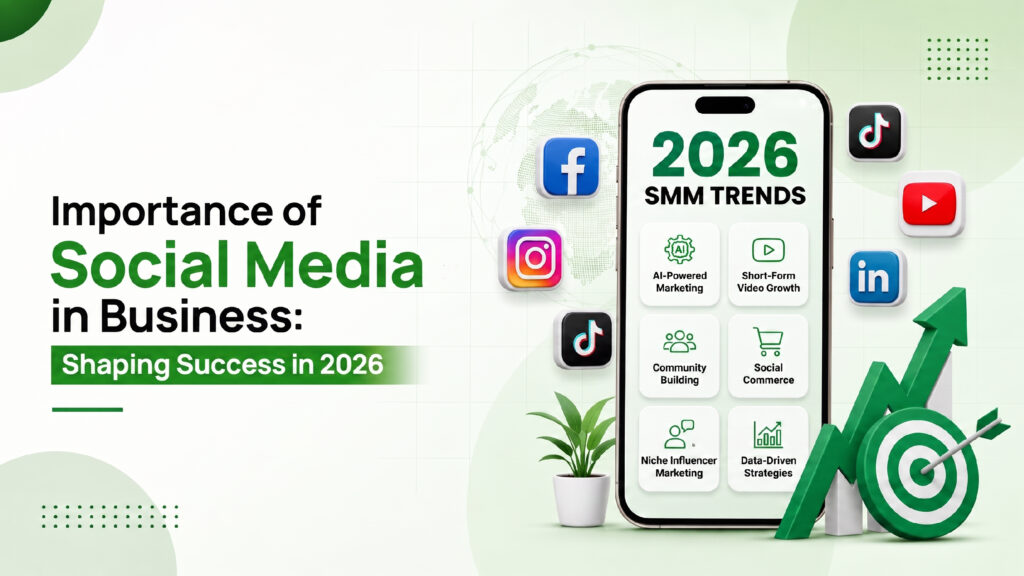
Importance of Social Media in Business: Shaping Success in 2026
Growing a business has always been challenging, especially when reaching new audiences, building trust, increasing sales, and maintaining customer loyalty are top priorities.
Before the digital era, businesses relied on physical stores, word-of-mouth, traditional advertising, and face-to-face communication to attract customers; these methods worked, but limited reach made expansion difficult.
The new media age transformed communication through computers, the internet, websites, email, search engines, and mobile devices, removing many barriers. Businesses could reach beyond physical locations, and people could easily discover and compare brands. However, a more personal, engaging way to connect with audiences remained needed.
Then social media arrived and changed how businesses build visibility and communicate with customers. Platforms allowed brands to share content, answer questions, collect reviews, and create communities, making social media for business an important digital growth channel.
It has also transformed advertising into conversation through comments, messages, stories, reviews, and shares, helping businesses build stronger customer relationships.
Technologies such as conversational marketing and social media tools improve communication, personalization, and efficiency. Together, these developments help businesses move customers from awareness and engagement toward trust, leads, sales, and retention.
Convex Interactive highlights the importance of social media in business to help brands strengthen customer relationships, improve engagement, and stay competitive in 2026.
Role of Social Media in Business: Building Visibility, Trust, and Growth
Social media has become an essential part of modern business communication and marketing. Its role continues to evolve as businesses use it to connect, engage, and grow. Its key benefits include:
1. Search Has Gone Social
Search has gone social as consumers, especially younger generations, use TikTok, Instagram, and YouTube as primary search engines, alongside Google, to discover products, read reviews, and find answers. Businesses can use keyword-rich content to drive discovery, while videos provide visual evidence and build trust.
AI is shaping the future of digital marketing, prompting platforms like ChatGPT, Gemini, and Google AI Overviews to crawl public social data, including captions, comments, and community discussions. Therefore, actively engaging on social media platforms can help businesses drive new brand awareness, attract intent audiences, and convert discovery into SEO traffic.
2. AI Search Cites Social Content
Modern AI Search platforms, including Google AI Overviews and ChatGPT, analyze public posts, reviews, forums, and discussions. Consistent brand mentions help LLMs build entity links, relevance, and authority, while fresh content offers real-time context and boosts visibility in AI answers.
Therefore, customer reviews, influencer content, and community discussions provide third-party validation and sentiment signals. Public profiles expand a brand’s digital footprint, giving AI systems more contextual data to analyze and cite. Active content marketing strengthens visibility, credibility, and the potential for recommendations.
3. Multi-Account Distribution Has Matured
Multi-account distribution strengthens digital marketing by using coordinated platform profiles to multiply organic reach and audience targeting. Businesses can adapt one core idea into targeted posts, test different content angles, and reduce dependence on a single account. This also spreads algorithmic risk and broadens visibility across various audience segments.
Centralized scheduling, content planning, and performance analytics make multi-account marketing more efficient and consistent. Each platform can use tailored posts to improve engagement, audience relevance, and organic discovery. As a result, multiple accounts become scalable digital marketing channels for sustained growth and visibility.
4. Competitive Advantage Lives on Social
Social media in business provides a competitive edge through real-time engagement, social listening, and competitor intelligence. Audience segmentation, targeted advertising, and sentiment analysis help businesses reach high-intent audiences. Real-time analytics and content optimization enable faster decisions and market adaptation.
Additionally, social listening tools track brand sentiment, customer behavior, emerging trends, and competitor activity. Performance analytics and data-driven insights help optimize campaigns, the customer experience, and brand authority. These technologies improve digital positioning and strengthen long-term competitive advantage.
5. Smarter, More Efficient Marketing
Social media enables efficient marketing through real-time analytics, audience segmentation, and precise targeting. These technologies optimize ad spend, automate campaigns, and improve customer acquisition and conversion rates. Integrated social commerce further streamlines the customer journey from engagement to purchase.
Moreover, real-time feedback and behavioral data continuously support content optimization and campaign refinement. User-generated content, social sharing, and sentiment analysis strengthen engagement and brand credibility. Together, these data-driven processes improve marketing ROI, scalability, and long-term growth.
6. Real-Time Engagement Is Expected
Platforms enable real-time marketing through instant support, interactive posts, and AI-driven insights. These tools track audience behavior, brand mentions, and engagement through social listening and analytics. Digital marketing trends help businesses improve response times, targeting, and marketing efficiency.
Therefore, real-time platform communication builds trust through rapid support and public engagement. Analytics optimize customer retention, brand sentiment, and campaign performance, enabling faster, data-driven growth across digital platforms.
7. Build Brand Trust
Social media platforms build brand trust through authentic marketing, transparent communication, and customer posts. Behind-the-scenes content, direct engagement, and user reviews strengthen brand credibility and social proof. Sentiment analysis and engagement metrics gauge audience trust and perceptions of the importance of social media in business.
Furthermore, consistent platform activity improves transparency, responsiveness, and customer retention. Positive reviews and real-time interactions enhance brand sentiment and credibility, as businesses build stronger trust through authentic, data-driven marketing.
FAQs
Why is a social media presence important for business?
A social media presence is vital because it lets businesses build brand awareness, communicate directly with customers, and drive new sales. Consumers use platforms like Instagram and Facebook to find and evaluate brands before they buy.
Can social media really make a difference to my business growth?
Yes, social media can make a big difference for your business. It puts your brand where people spend their time, helping you reach new buyers, build trust, and increase sales without spending much money.
How does social media help a business turn followers into customers?
Social media turns followers into customers by building trust, sharing proof, and guiding people through clear steps from a brand’s online profile to a purchase. It bridges the gap between casual interest and real sales through consistent engagement.
Can social media turn attention into sales?
Yes, social media can turn attention into sales, but it requires a deliberate conversion path rather than simply accumulating views or likes. Moving people from casual viewers to paying customers relies on building trust, reducing buying friction, and guiding them through a clear funnel.
What is the role of social media in business?
The role of social media helps businesses build brand awareness, communicate directly with customers, and sell products by providing a cost-effective way to reach new buyers and grow.