What Is an OTT Platform? A Complete Guide for Businesses
There was a time when television was the center of home entertainment, and families gathered around the screen to watch their favorite shows at a scheduled time. Back then, cable and satellite TV were the main ways to enjoy entertainment, leaving viewers with limited choices about what to watch and when.
As internet access expanded, OTT technology emerged to deliver video, audio, and other media directly to viewers over the internet, bypassing traditional cable, satellite, and broadcast television providers. This gave audiences more flexibility in how they access content and paved the way for OTT platforms to change the way people watch and enjoy digital media.
This shift raises an important question: What is an OTT platform, and why has it become such a common part of digital entertainment? Simply put, an OTT platform delivers video and audio content directly over the internet, enabling people to access their preferred content without relying on traditional cable or satellite TV.
Today, OTT platforms offer more than a convenient way to watch videos; they also create new opportunities for businesses, broadcasters, and content creators to reach audiences online.
Convex Interactive explains how OTT platforms work, the different types and business models, their key features, and what businesses need to know before launching a streaming service.
What Is an OTT Platform?
An OTT platform is a digital service that delivers video and audio content directly to viewers over the internet, without requiring traditional cable or satellite television. In simple terms, it allows audiences to access their preferred content anytime, anywhere, through an internet connection.
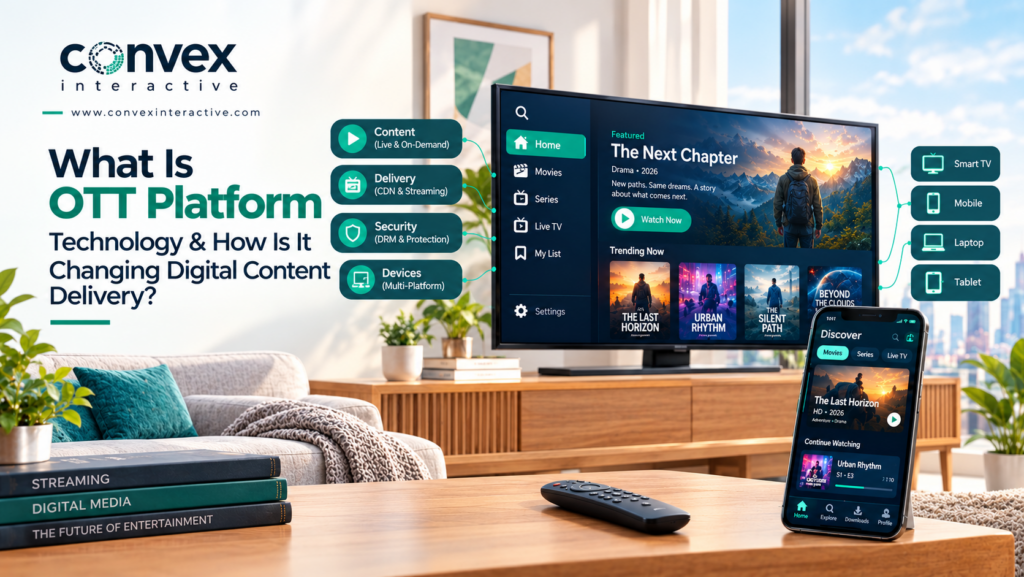
Beyond content delivery, OTT services, also known as over-the-top media services, give businesses a direct way to distribute content across smartphones, smart TVs, laptops, tablets, and other connected devices. This makes it easier to reach audiences across different screens without relying on traditional television networks.
Depending on the platform and its business model, audiences may access content through subscriptions, advertisements, pay-per-view, or a combination of different models. As a result, businesses can choose how to offer their content based on audience preferences, content type, and revenue goals.
More than just a way to watch videos online, OTT represents a shift in how digital content is delivered, accessed, and monetized. This flexibility makes OTT increasingly relevant for broadcasters, creators, brands, and businesses looking to distribute content directly and build stronger relationships with their audiences.
How Does an OTT Platform Work?
An OTT platform starts with video or audio content, such as movies, TV shows, or live broadcasts, prepared for online streaming. The content is then encoded into formats and resolutions that work across different devices and screen sizes.
Once the content is ready, it is stored on servers and delivered through a Content Delivery Network (CDN), which helps viewers access videos quickly and reduces delays. The platform also manages content, user accounts, payments, and security before making everything available through its website or app.
Finally, viewers can browse the available content and stream their chosen videos on smartphones, computers, smart TVs, and other connected devices. The platform works behind the scenes to deliver the content efficiently, helping create a smoother viewing experience across different internet connections.
How an OTT Platform Delivers Video to Viewers
1. Content:
Collecting movies, shows, and live broadcasts for online distribution.
2. Encoding:
Converting content into suitable formats and resolutions for streaming.
3. Storage and CDN:
Storing content and delivering it efficiently through distributed servers.
4. Platform and Security:
Managing user accounts, access permissions, payments, and content protection.
5. Apps and Viewers:
Making content available for streaming on smartphones, smart TVs, tablets, and computers.
OTT Devices
Viewers can watch OTT content on smartphones, tablets, laptops, smart TVs, and streaming devices that connect a regular TV to the internet. Many game consoles and casting devices also support OTT apps. A good platform works consistently across the devices its audience actually uses.
OTT Apps vs OTT Platforms
An OTT platform is the full system behind the service: content management, delivery, payments, and security. An OTT app is the part viewers see and use on a phone, smart TV, or the web. A business needs both: the platform runs the service, and the apps put it in viewers’ hands.
Key Components of an OTT Platform
Several components work together to keep an OTT platform organized, secure, and easy to use, from managing content to helping viewers access their favorite videos.
- Content management: Organizes videos, categories, descriptions, and publishing schedules.
- Video encoding: Prepares content in suitable formats and resolutions for streaming.
- Content Delivery Network (CDN): Delivers content efficiently through a network of distributed servers.
- DRM security: Helps protect licensed content from unauthorized access and copying.
- Multi-device apps: Allow viewers to watch content on smartphones, smart TVs, tablets, and computers.
- Payment systems: Handle subscriptions, rentals, and other payment options.
- Analytics: Tracks viewing activity and engagement to help businesses understand audience behavior.
Adaptive Bitrate Streaming
Adaptive bitrate streaming automatically adjusts video quality based on the viewer’s internet speed, helping reduce buffering and interruptions when the connection slows down. This ensures smooth playback by switching resolutions to maintain a consistent stream across network conditions.
Technologies such as HLS (HTTP Live Streaming) and DASH (Dynamic Adaptive Streaming over HTTP) enable the video player to switch between quality levels as network conditions change.
Types of OTT Platforms and Business Models
OTT platforms use various business models to deliver content and generate revenue. Some charge viewers a regular subscription fee, while others offer free content supported by advertising or charge for individual movies and events. The right approach depends on the content type, the target audience, and viewers‘ preferred payment methods.
1. By Monetization Model (Video-on-Demand Types)
1. SVOD (Subscription Video on Demand)
SVOD platforms charge viewers a recurring monthly or annual fee to access a library of content. Netflix, Apple TV+, and Disney+ are examples of subscription-based streaming services.
2. AVOD (Advertising Video on Demand)
AVOD platforms offer free content and earn revenue by displaying advertisements before, during, or after videos. YouTube and Tubi follow this advertising-supported model.
3. HVOD (Hybrid Video on Demand)
HVOD combines subscription access with advertising, allowing platforms to offer lower-cost ad-supported plans alongside premium options. Hulu and Paramount+ offer examples of services with different viewing and payment options.
4. TVOD (Transactional Video on Demand)
TVOD lets viewers pay a one-time fee to rent or purchase individual movies and TV shows instead of paying for a full content library. Examples include rentals and purchases through the Apple TV app and Google Play Movies.
5. FAST (Free Ad-Supported Streaming TV)
FAST platforms provide free, scheduled TV-style channels over the internet, with revenue generated through commercial breaks. Pluto TV, The Roku Channel, and Samsung TV Plus are examples of this model.
2. By Live and Linear Content
1. vMVPDs (Virtual Multichannel Video Programming Distributors)
vMVPDs deliver bundles of live television channels over the internet as an alternative to traditional cable or satellite packages. Examples include YouTube TV, Fubo, and Sling TV.
2. Live Sports and Event OTT
These platforms stream live sports, concerts, and other events, earning revenue through subscriptions, advertising, or pay-per-view access. ESPN+ and DAZN are examples of services offering sports content online.
3. By Content and Function Category
1. Video OTT
Video OTT platforms deliver movies, TV series, documentaries, user-generated videos, and educational or fitness content over the internet. Netflix and YouTube are familiar examples serving different types of video audiences.
2. Audio and Music OTT
Audio OTT platforms stream music, curated radio stations, and podcasts, often through subscriptions or advertising. Spotify and Apple Music are examples of services built around digital audio.
3. Voice Services (VoIP)
Voice OTT services allow users to make voice calls over the internet instead of relying solely on traditional cellular voice networks. WhatsApp, Skype, and Zoom offer internet-based calling features.
4. Instant Messaging OTT
Instant messaging OTT services let users exchange text messages, images, videos, and other media over the internet, often bypassing traditional SMS networks. WhatsApp and Telegram are examples of internet-based messaging services.
In terms of content, OTT platforms can offer video on demand (VOD), live streaming, and audio streaming, depending on their audience and business goals.
How Do OTT Platforms Make Money?
An OTT platform’s revenue model depends on its business model. Subscription-based services generate recurring income from monthly or annual payments, while advertising-supported platforms earn from brands that want to reach their viewers.
Transactional platforms, on the other hand, earn revenue when users rent or purchase specific content, making them suitable for premium releases, special events, and pay-per-view broadcasts.
Many platforms also combine different revenue models to reach a wider audience. For example, a service may offer free, ad-supported content to attract viewers while providing a paid subscription for those who want additional content or fewer interruptions, giving users more choice and allowing the business to earn from different audience segments.
The Role of Advertising in OTT
OTT advertising gives brands a chance to reach audiences as they watch digital content. Advertisements may appear before a video starts, during playback, or between programs, depending on the platform’s design.
For OTT businesses, advertising can be an additional revenue stream, especially when the service attracts a large, engaged audience.
OTT vs Traditional TV vs IPTV
Although OTT, traditional TV, and IPTV all deliver video content, they differ in how viewers access it. Traditional TV relies on broadcast, cable, or satellite, while OTT uses the internet and IPTV typically operates over a managed network.
| Feature | OTT | Traditional TV | IPTV |
| Content Delivery | Delivered over the open internet | Delivered through broadcast, cable, or satellite signals | Delivered through a managed IP network |
| Devices | Smartphones, smart TVs, tablets, and computers | TVs with broadcast, cable, or satellite equipment | TVs and compatible devices, often through a set-top box |
| Cost | May use subscriptions, ads, rentals, or free access | Often requires a cable or satellite package | Usually offered through a service provider’s package |
| Personalization | Often includes recommendations and personalized profiles | Limited; most viewers get the same scheduled programming. | Depends on the provider and service features |
| Interactivity | Supports on-demand viewing and user-selected content | Mostly follows scheduled programming | May offer on-demand content and interactive features |
The main difference between OTT and IPTV is how they deliver content. OTT streams over the open internet, letting viewers watch on different devices and in different locations, while IPTV usually relies on a network managed by a service provider.
Traditional TV mainly follows scheduled programming, whereas OTT allows viewers to choose what they want to watch and when. IPTV can also offer on-demand content, but its features depend on the service provider.
Key Features of a Good OTT Platform
A good OTT platform needs more than a video library, as it should make content easy to access, provide a smooth viewing experience, and give businesses the tools to manage and grow their services.
- Multi-Device Support: Works across smartphones, tablets, smart TVs, and computers.
- Adaptive Streaming: Adjusts video quality according to internet speed to reduce buffering.
- Content Management: Makes it easy to upload, organize, update, and publish content.
- Security and DRM: Helps protect digital content from unauthorized access and copying.
- Monetization Options: Supports subscriptions, advertising, rentals, and other revenue models.
- Personalization: Recommends content based on viewers’ interests and viewing habits.
- Analytics: Tracks audience activity, engagement, and content performance.
- Live and On-Demand Streaming: Allows viewers to watch live broadcasts and recorded content on the same platform.
These features help businesses deliver content more reliably, understand audience preferences, and manage services efficiently. Choosing the right combination also makes it easier to adapt the platform as the business and its audience grow.
Popular OTT Streaming Platforms: Examples
Several well-known platforms demonstrate how OTT services deliver various types of digital content:
- Netflix: Offers movies, series, documentaries, and other video content via subscription plans.
- YouTube: Lets users watch and share videos, with revenue generated through advertising and other features.
- Disney+: Provides movies, series, and other entertainment content via a subscription-based streaming service.
- Spotify: Delivers music, podcasts, and other audio content via free and paid listening options.
These examples show that OTT services can focus on video entertainment, user-generated content, or audio streaming, depending on their audience and business model.
OTT in Pakistan: Growth and Opportunity
Internet access and mobile connectivity are creating more opportunities for digital content services in Pakistan, allowing people to access online entertainment, streaming platforms, and other digital services more easily through their connected devices.
According to DataReportal’s Digital 2026: Pakistan report, the country had approximately 117 million internet users in October 2025, while 194 million cellular mobile connections were active in late 2025. These figures highlight the scale of Pakistan’s connected audience, although mobile connections do not represent unique users or smartphone ownership.
As viewing habits shift towards digital platforms, local broadcasters, brands, and content creators can reach wider audiences beyond traditional television and make their content accessible online.
An OTT platform lets businesses offer live or on-demand content and earn through subscriptions, advertising, or paid access, but success depends on reliable streaming, relevant content, and affordable access.
How to Launch Your Own OTT Platform
Launching an OTT platform starts with understanding your audience, content, and goals. Plan carefully to choose the right development approach and meet viewers’ needs.
Steps to launch an OTT platform are as follows:
1. Define Your Audience and Content
Identify your target audience and decide what content you will offer, such as entertainment, educational videos, sports, or live events.
2. Choose a Business Model
Select a revenue model based on your goals, such as subscriptions, advertising, pay-per-view, or a combination.
3. Choose White Label or Custom Development
Decide whether an existing solution or a platform built around your specific requirements better suits your business.
4. Build the Platform and Apps
Develop the website and applications needed to deliver content across the devices your audience uses.
5. Test and Secure the Platform
Before going live, check streaming quality, payment processes, user access, device compatibility, and content protection.
6. Launch and Promote
Introduce your service through social media, digital marketing, partnerships, and other channels to attract your target audience.
What Does It Cost to Build an OTT Platform?
The cost of an OTT platform depends on the features you need, the number of apps and supported devices, and the size of your content library. A service offering basic video streaming may require a different setup than one that includes live broadcasts, multiple user profiles, advanced analytics, and multiple payment options.
Additionally, ongoing expenses matter, including video storage, bandwidth, streaming delivery, maintenance, and updates. A white-label solution may reduce initial development work, while custom development can require more resources depending on the design and functionality involved.
White Label vs Custom OTT Platform
A white-label OTT platform suits businesses that want to launch with an existing solution and their own branding, while custom development is better for businesses that need specific features, integrations, or greater control over the platform. The right choice depends on your launch plans, available resources, and long-term business requirements.
Do You Need Your Own OTT Platform?
An OTT platform can help businesses and professionals distribute content directly to their audiences without relying entirely on traditional broadcasting channels. It can be useful for organizations seeking to expand their digital reach, offer exclusive content, or create new revenue streams.
- Broadcasters: Extend their reach by making programs available online.
- Content Creators: Offer exclusive videos and build a dedicated audience.
- Educators: Deliver recorded lessons, online courses, and live classes.
- Brands: Share branded videos, product information, and training content.
- Event and Sports Organizers: Stream live events, matches, and recorded highlights.
Convex Interactive has developed Mjunoon.tv, its own OTT platform, to support the delivery of live and on-demand content across mobile devices, smart TVs, and the web. It provides businesses with a way to bring their content to digital audiences while shaping their streaming experience around their content strategy, audience needs, and business goals.
FAQs
What does OTT stand for?
OTT stands for Over-The-Top and refers to delivering video and audio content directly over the internet, rather than through traditional cable, satellite, or broadcast networks, allowing audiences to access content on connected devices.
Are Netflix, Disney+, and Amazon Prime Video OTT platforms?
Yes, Netflix, Disney+, and Amazon Prime Video are popular OTT platforms that deliver movies, shows, and other digital content over the internet, allowing viewers to watch on smartphones, smart TVs, computers, and other supported devices.
How do OTT platforms make money?
OTT platforms typically generate revenue through subscriptions, advertising, pay-per-view, or rentals, while some combine multiple models to give viewers different ways to access their content and build sustainable revenue streams.
What Is the Difference Between OTT and IPTV?
OTT delivers content over the open internet, while IPTV generally uses a managed network operated by a telecom or internet service provider, so the main difference is how they deliver content to viewers.